This blog is dedicated to our Journalists for Rainwater Harvesting. They will report on examples of rainwater harvesting in their own countries and communities, helping us raise the profile of rainwater harvesting - both locally and globally.

Sunday, 1 December 2013

An effort for the positive beginning


An  effort for the positive beginning 
Bhuikhel, a place located near a world heritage site Swayambhunath, has a pleasant environment. I along with my colleague visited the site. It was beautiful but we also could see a dried out pond even though two recharge wells could clearly be seen. Later we came to know that the ultimate reason for constructing the wells was for retaining and recharging rainwater. Unfortunately rainwater is only being recharged.  It has 3 collection inlets: two being the stairs of the Swayambhunath and one being the 9 ropani playground lying next to the pond. However, the local authority had tried to use black mud so that water could be retained but still the technique failed.

 
Bhuikhel pond

“The formation of the cracks in the bedding of the black mud used in the pond is not letting the pond to retain rainwater”, says Narendra Man Dangol, director of Niva Rain and the local resident. He also shared, “the decision to use red mud or plastic for overcoming the problem is yet to be made.”
Kathmandu Metropolitan City (KMC) has introduced a provision that waives 10 per cent amount while approving house blueprints if they have integrated RWH in their design. It has also enforced a mandatory provision of approving the construction of only those houses that incorporate the Rainwater Harvesting (RWH) system particularly in this area.

The effort  of KMC to encourage people to install RWH system in their household is highly commendable. And hopefully the pond could retain water not just recharge in times to come.


Friday, 15 November 2013

“Blue School taught us proper water management”- Pakistani Delegates


Nepal is considered to be second richest country in water resources but still there are many places where people have to travel hours to fetch single bucket of water. However blue schools in Thumki VDC of Kaski District proved that when there’s need people will find a way out to fulfil the need.  People in Thumki VDC previously had to travel for almost an hour and another hour to get a bucket of water but the situation is quite different at least in schools. Thanks to International rainwater Harvesting Alliance (IRHA) and Kanchan Nepal who promoted rainwater harvesting system in few schools of the VDC.

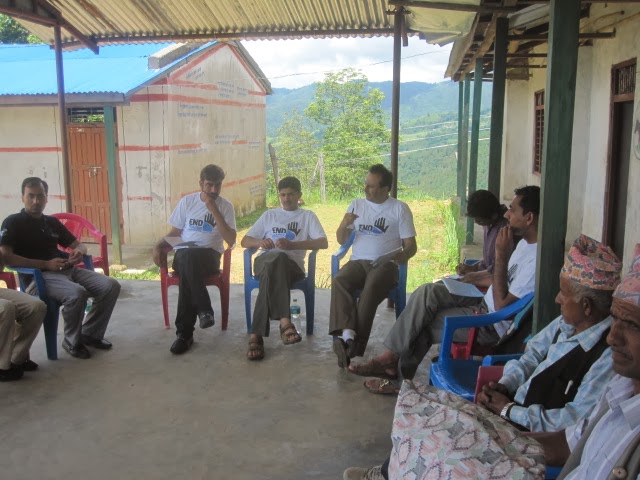
Delegates in meeting with the stakeholders
A team of Pakistani delegates visited the schools on 26th June 2013 to collect information on ongoing activities and its contribution in improving issues of WASH in the community. During the interaction session among school management committee member, project proponents and Pakistani delegates at Jateshwor Secondary School, Nirmal Adhikari, project coordinator at Kanchan Nepal said “A school should be a place where children wishes to go and do not run away. We have tried to develop blue school in same way.”  Thumki VDC previously had issues of water and sanitation but now after school has installed rainwater harvesting system, at least students get enough water to drink and for sanitation. “Around 60000 litres of water is collected in 5 tanks constructed in the school premise which is used for drinking and sanitation in the school and also is supplied to some of the households nearby occasionally” informed Tirtha Raj Neupane, Principal of Jateshwor Secondary School. The project proponents are satisfied that the project has brought significant changes in using water and improved sanitation in the area. However they are also continuously being requested by the community to help in installing rainwater harvesting system in their household. “Children have access to enough water for sanitation at school which they do not have in their house, this has invited some problem and obliged parents to manage enough water,” added Tirtha Raj Neupane.
Shahid drinking the rainwater

Along addressing issues of WASH blue school also incorporates issues of greenery, physical fitness and mutual respect and understanding.

The delegates visited Jateshwor Secondary School and Shivalaya Higher Secondary School in Thumki and gathered information on Blue Schools of the area. The delegates were interested in improvement of sanitation also. One of the Pakistani delegates, Ajmal Khan asked if sanitation in the community has improved to get positive answer from the community members.

Shivalaya School- Kaski
Another delegate Syed Mahazan praised the activities in blue school and said, “Blue school in Kaski are very impressive. I am from hilly region; though water is enough in my place its management is not proper. If Rainwater system can be installed and utilized properly, it’s possible that we will never face problem of water.”

The Pakistani delegate were on a week-long (25 June to 1st July 2013) visit to Nepal to collect information on WASH activities in Nepal and is expected to disseminate it in Pakistan.


Group photo at Jateshor Secondary School


Sunday, 10 November 2013

Belief in Rainwater Harvesting System


                                                                                                     -By Bimala Gurung
Nirmal Basti, a small community located in Lalitpur Sub-Metropolitan City of Nepal has so much to share about Rainwater Harvesting (RWH) system. At the entry point itself you can see a board of RWH. When I along with couple of my friends first visited the place, we first saw an encouraging board.

 
                Encouraging people to develop the community as a model for RWH system.

With the trust between the local people and external agencies and their joint effort, total of 22 RWH systems have already been constructed in this community solely for recharging a nearby community recharge well. From 13 rooftop catchments and 9 surfaces run off catchments, the rainwater is being recharged. Even the storm water is being managed and recharged in this well.


                                                     A community recharge well.


According to the reference data collected on 1 November, 2012, the outside diameter was 4’10” and inside diameter was 4”4”, the depth of water was 28’6”, water of 5’ was available and the level of water was 23’6”. The water level has certainly risen in the recharge well since then as when we collected data on 15 August, 2013, we found outside diameter to be 42” and inside diameter 38”, depth of water 27’9”, water of 8’5” available and the water level 19’4”.

The RWH system has definitely been beneficial to the community and its people yet during the months of March and April, the recharged well tends to dry out. The community people are forced to buy tanker costing them approximately Rs.600 per 1000 liter per month in average. Even though they have their complaints, they believe in years to come the well will be recharged enough and they can fully rely on the community well for water. What is more inspiring is the faith of the community people on RWH that it indeed is going to fulfill their water demand. They have all the right reasons too to have such faith...

Monday, 21 October 2013

Nepal's shifting rains and changing crops

By Saleem Shaikh.
Source: SciDevNet

[KATHMANDU] With weather becoming more erratic every year as a result of climate change, Nepali farmers are progressively shifting their approach, turning vast areas of rice paddies into small-scale vegetable farming. Vegetables are more resilient as they can be hand watered in case of drought. Farmers say that with rains that used to come in April now shifting as late as mid-June, vegetables that can be sown at the time the rains finally fall are now a better investment.

But large parts of their fields now remain uncultivated due to lack of water.

The situation raises concern among experts, who warn that a shift from rice to vegetable cultivation may harm food security. They also say that without adequate support from the government farmers’ livelihood could be at risk. According to researchers, there is now a need for insurance schemes, public subsidies and improved early-warning systems to forecast extreme weather.

Image courtesy of Saleem Shaikh.

Friday, 18 October 2013

Water harvesting helps Kenya's women cope with failing rains


by James Karuga

Source: Thomson Reuters Foundation - Fri, 20 Sep 2013 12:30 AM


Rose Wanjiku draws rainwater she harvested from a water tank in Ngurubani in Central Kenya province. THOMSON REUTERS FOUNDATION/James Karuga
NGURUBANI, Kenya (Thomson Reuters Foundation) – When Rose Wanjiku first moved to her home in Central Kenya province 14 years ago, the region received four months of rain every year. The rains began in April and again in October, and were sufficient for a small-scale farmer such as herself to grow staples like maize and beans to feed her family and sell the surplus at local markets.

Today the Ngurubani area gets only two months of rain a year. Because of the growing scarcity, Wanjiku has resorted to irrigating her crops with water pumped from the Thiba River when rains fail in mid-season. Even though the river is just a stone’s throw away from her house and fields, the water pump means extra expenses for her household.  

“Farming has become very expensive for us these days. We hardly make profits,” said her husband Munene. His wife added that the river water cannot be used for household purposes because it is too muddy.

To counter the water shortages, Wanjiku, 45, has begun harvesting rainwater. Her roof is fitted with gutters and through a loan from SMEP, a Kenyan microfinance programme, she has bought a 2,300-litre (600-gallon) water tank to store the harvested water.

Rainwater gathered since April has been sustaining her household until the rains are due to begin again next month.

Wanjiku began making loan payments of 1,000 Kenyan shillings (around $11) a month in February, and aims to clear the loan by November.

The frustrations of poor rainfall also have taken a toll on Margaret Njeri Muthee, 38, another farmer and secretary of the 12-member Wendani Women’s Group, which also counts Wanjiku as a member.

Njeri recalls that when she first moved to Ngurubani 15 years ago, rains were regular and she was able to harvest up to two 90kg bags of beans per acre of land.  Today she gets half a bag of beans at most.

“The weather has really changed here – there is a chill I never saw before, destroying our staples,” Njeri said. Because of the unpredictable weather and poor crop yields, Njeri now rears pigs, in addition to chickens and cattle.

“I’m tired of farming maize and beans,” she added.  

As a result of increasingly short rainfall, Njeri was spending 400 shillings (nearly $5) every week to pay for a donkey-drawn cart to fetch water from the Thiba River, over a kilometre away from her home. But now she, too, has a water tank, bought on credit from SMEP.

Njeri and Wanjiku are among over 7,000 Kenyan recipients of an ongoing water credit scheme accessed through microfinance institutions such as SMEP. The scheme enables households to buy tanks to capture and store clean rainwater that runs from rooftops along the gutters.

WIDESPREAD WATER STRESS
UNESCO reports that 17 million of Kenya’s 41 million inhabitants lack access to safe water. 
Of the loan recipients, 92 percent are women. According to Patrick Alubbe, East Africa regional director of Water.Org, a nongovernmental organisation, it is the women in households who must spend hours searching for water, and this makes them appreciate the scheme, as it saves them time.

SMEP has given 821 water-related loans so far, with repayment rates of more than 90 percent, according to Fridah Njeru, SMEP’s senior programmes coordinator.

Kenya has 29,000 beneficiaries of water-related loans countrywide, with some funds going to building latrines or fix sewer systems to improve sanitation. The scheme also operates in Uganda, Bangladesh and India.

With a tank to harvest rainwater, Wanjiku says she no longer needs to wait for mud in collected river water to settle at the bottom of her containers so that she can use it at home.

Kenya’s average annual rainfall is 630 mm, which qualities it as a water-scarce country, according to a study published by the U.N. Food and Agriculture Organization. However, a study by the Southern and Eastern Africa Rainwater Network notes that large groundwater aquifers represents a valuable water resource not directly related to or dependent on rainfall patterns.

Experts are pointing to aquifers as the country’s next important source of water. This comes following the recent discovery of aquifers in the drought-hit Turkana region in Kenya’s north, where rainfall does not exceed 450mm annually.

The aquifers are reported to hold 250 billion cubic metres – enough to supply Kenya’s needs for 70 years at the current rate of consumption of 3 billion cubic metres a year.

James Karuga is a Nairobi-based journalist interested in agriculture and climate change issues

Monday, 16 September 2013

University of Agricultural Sciences, Bangalore's RWH effort

picture: K Gopinathan: Hindu. Watershed tank filled to the brim on the UAS campus.
The varsity has dredged and cleaned the ponds and tanks across its 1300 acre campus in Bangalore, India. With Bangalore experiencing unprecedented showers in great abundance in 2013, the University has taken the initiative to clean up its six watershed ponds besides the six minor ones. They are all brimming with water with the excess rain. De-silting and clearing the obstacles in the connecting network of storm water drains have helped to direct the rain water into the ponds across the campus.

" We have 56 bore-wells on the university campus. Of them 20 had gone dry and now have sprung back to life," says MA Shankar, UAS-B Director of Research. " In addition people who live in the surrounding areas have happily confirmed that their dried borewells have also sprung to life."

This is a great lesson for Bangalore, reeling just recently from a fresh water shortage. " Historically Bangalore had hundreds of tanks to collect all the rain that fell across the city. These kept the water table up. We need to go back to that tradition," says Professor Shankar.

The University is willing to help the civic authorities of Bangalore in recharging ground water with the success that they have achieved.

Hope someone is listening!

Wednesday, 29 May 2013